Construction projects are becoming more complex than ever. Modern developments require multiple professionals to work together throughout the project lifecycle.
These typically include:
- Architects
- Structural Engineers
- Electrical Engineers
- Plumbing Engineers
- Surveyors
- Contractors
Managing all these disciplines efficiently is one of the biggest challenges in construction. Poor coordination can lead to design conflicts, delays, increased costs, and costly rework during construction.
This is where Building Information Modeling (BIM) is transforming the industry.
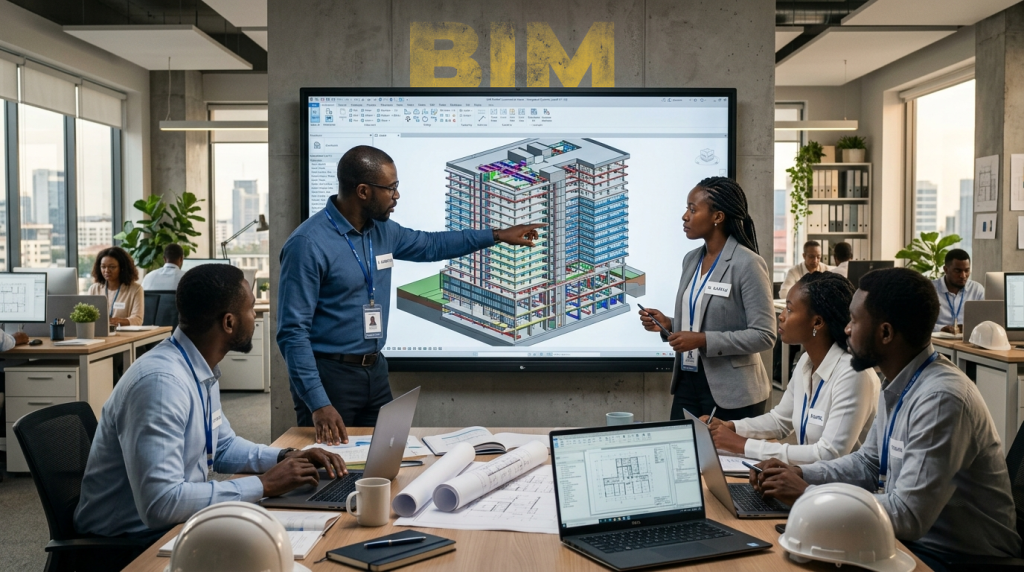
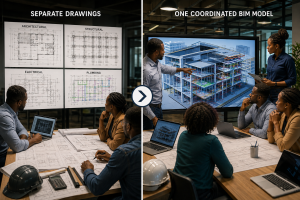
Instead of relying on separate drawings and disconnected information, BIM enables every project participant to collaborate using one intelligent digital model.
What Is Building Information Modeling (BIM)?
Building Information Modeling (BIM) is a digital process used to create an intelligent 3D model of a construction project.
Unlike traditional drawings, BIM models contain valuable information about every element of the project, including:
- Geometry
- Materials
- Quantities
- Costs
- Construction sequencing
- Maintenance requirements
Think of BIM as a digital twin of a future building, allowing engineers, architects, contractors, and clients to visualize and manage the project before construction even begins.
Why BIM Is Different from Traditional Drawings
Traditional construction projects rely on separate drawings prepared by different disciplines.
These usually include:
- Architectural Drawings
- Structural Drawings
- Electrical Drawings
- Plumbing Drawings
Because these drawings are produced independently, coordination problems can occur if changes are not communicated effectively.
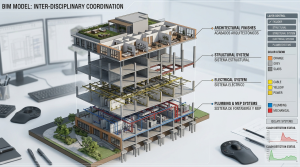
BIM combines all disciplines into one coordinated digital model.
This allows every team member to work from the same information, improving communication and reducing design conflicts before construction begins.
How BIM Works
All project disciplines work within a shared digital environment.
When one element is modified, related information updates automatically throughout the model.
For example, if a wall changes position, BIM can automatically update:
- Doors
- Windows
- Finishes
- Quantities
- Schedules
- Associated building elements
This significantly improves project coordination while reducing manual updates and drawing inconsistencies.
Levels of BIM
As BIM technology has evolved, additional dimensions have been introduced to improve project planning and management.
3D BIM – Design Visualization
Provides a three-dimensional representation of the project, helping designers and clients clearly understand the proposed building before construction begins.
4D BIM – Construction Scheduling
Adds time and construction sequencing to the model, allowing project teams to visualize how the building will be constructed over time.
5D BIM – Cost Management
Integrates cost information with the model, making budgeting, quantity take-offs, and cost forecasting more accurate.
6D BIM – Sustainability and Lifecycle Management
Includes sustainability information and lifecycle data to support energy efficiency and long-term building performance.
7D BIM – Facility Management
Stores maintenance and operational information that assists facility managers after the building has been completed.
Benefits of BIM
Building Information Modeling provides significant advantages throughout the project lifecycle.
Better Visualization
Clients and stakeholders can clearly understand the finished project before construction starts.
Clash Detection
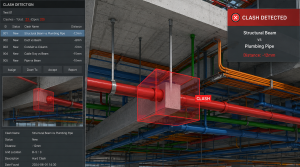
One of BIM’s greatest advantages is identifying conflicts between different building systems before work begins on site.
These conflicts may involve:
- Electrical conduits
- Plumbing pipes
- HVAC systems
- Structural beams
- Columns
Resolving clashes during design is far less expensive than correcting them during construction.
Improved Coordination
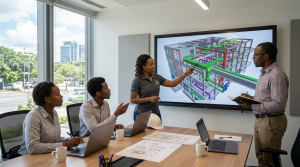
Architects, engineers, contractors, and consultants all work from the same coordinated model, reducing communication errors.
Reduced Rework
Detecting problems early minimizes construction changes, delays, and unnecessary costs.
Better Cost Control
Material quantities can be extracted directly from the BIM model, improving estimating accuracy and budget management.
Improved Project Planning
Construction sequencing becomes easier to visualize, helping teams improve scheduling and site coordination.
Image Placement: BIM software highlighting clashes between structural beams and mechanical services.
Real-World Example
Imagine a plumbing pipe passing directly through a reinforced concrete beam.
With traditional drawings, this conflict may only be discovered after construction has already started, resulting in delays, redesign, and additional costs.
With BIM, the clash is detected digitally during the design stage.
The design team resolves the issue before construction begins, saving both time and money while avoiding unnecessary site modifications.
BIM in Building Projects
Building Information Modeling is widely used across many building projects, including:
- Office Buildings
- Hotels
- Hospitals
- Residential Developments
- Schools
- Shopping Centres
By improving coordination between different disciplines, BIM helps deliver projects more efficiently and with fewer construction errors.
BIM in Infrastructure Projects
BIM is no longer limited to buildings.
Today, it is increasingly being used for major infrastructure developments such as:
- Roads
- Bridges
- Railways
- Airports
- Industrial Facilities
As infrastructure projects become larger and more complex, BIM provides better planning, coordination, and asset management throughout the project lifecycle.
Challenges of BIM Implementation
Although BIM offers many benefits, successful implementation requires organizational commitment and investment.
Some common challenges include:
Training Requirements
Project teams must develop new technical skills to work effectively within BIM environments.
Software Investment
Professional BIM software and supporting technology require an initial financial investment.
Process Changes
Organizations often need to adapt traditional workflows to fully benefit from BIM.
Data Management
Large BIM projects generate significant amounts of information that must be properly managed and maintained.
The Future of BIM
Construction is becoming increasingly digital.
Emerging technologies are expanding BIM capabilities through:
- Artificial Intelligence (AI)
- Digital Twins
- Real-Time Project Monitoring
- Cloud Collaboration
- Augmented Reality (AR)
These innovations are transforming the way projects are planned, designed, constructed, and managed.
As technology continues to evolve, BIM is becoming the foundation of modern project delivery across the construction industry.
OAC Project Thinking
At On Africa Construction, BIM represents more than software.
It represents a smarter way of planning, designing, coordinating, and delivering construction projects.
Successful BIM implementation improves:
- Project coordination
- Construction efficiency
- Cost control
- Quality management
The earlier problems are identified, the easier and more affordable they are to solve.
Conclusion
Building Information Modeling is transforming the construction industry by creating intelligent digital models that improve collaboration, reduce design conflicts, enhance project planning, and support better decision-making.
As projects continue to grow in complexity, BIM is becoming an essential tool for architects, engineers, contractors, and project owners seeking greater efficiency and better project outcomes.
Key Takeaways
- BIM stands for Building Information Modeling.
- BIM creates intelligent digital models that improve project coordination.
- BIM helps detect clashes before construction begins.
- BIM supports better planning, budgeting, and lifecycle management.
- BIM is becoming an essential technology for modern construction and infrastructure projects.

At On Africa Construction, we believe technology and engineering work together to deliver better projects, smarter decisions, and more successful outcomes.