Understanding the Hidden Layers of a Road
When most people look at a road, they only see the asphalt or concrete surface. However, a road is much more than what appears on top. Beneath every well-constructed road lies a carefully engineered system of layers designed to distribute loads, provide stability, and ensure long-term durability.
Without these layers, roads would quickly crack, sink, and fail under traffic.
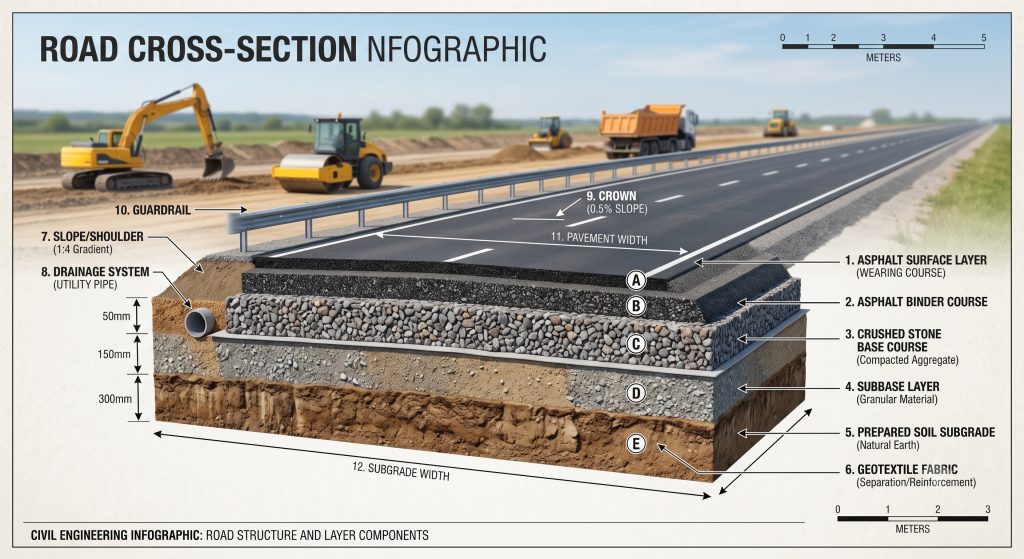
The Surface Layer
The top layer is the part drivers see every day. It provides a smooth driving surface, resists wear, and protects the layers below from weather and traffic.
Depending on the project, this layer may consist of asphalt or concrete.
The Base Course
Directly beneath the surface lies the base course. This layer is typically made from crushed stone or high-quality aggregates.
Its primary role is to distribute vehicle loads and provide structural strength.
The Subbase
Below the base course is the subbase layer. This layer helps improve drainage and provides additional support.
The subbase acts as a bridge between the base course and the natural ground.
The Subgrade
The subgrade is the natural soil upon which the road is built.
Before construction begins, engineers carefully test and prepare the subgrade to ensure it can support the road structure.
A weak subgrade can lead to road failures regardless of how strong the upper layers are.
Why Multiple Layers Are Important
Each layer serves a specific purpose:
- Surface layer: Smooth driving experience
- Base course: Structural support
- Subbase: Drainage and load distribution
- Subgrade: Foundation of the entire road
Together, these layers create a road capable of supporting thousands of vehicles every day.
Conclusion
Road construction involves much more than laying asphalt. Every successful road depends on a carefully engineered system of layers working together beneath the surface.
Understanding these hidden components helps explain why quality construction practices are essential for durable infrastructure.